
Above ground pools · UK
Above ground pools
for UK gardens.
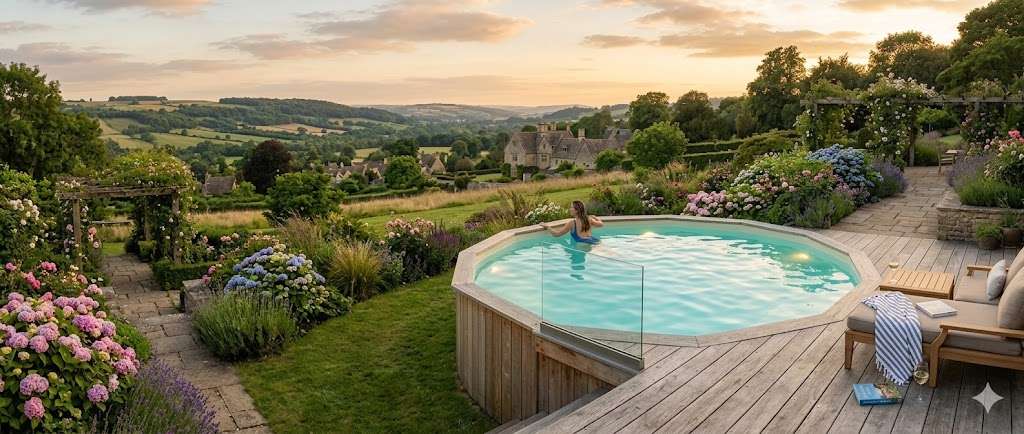
No excavation. No planning permission. A beautiful wooden above ground pool that's ready to swim in within weeks — and looks like it belongs in your garden.
What types of above ground pool are there?
Above ground swimming pools fall into three broad categories, and the differences matter more than most buyers realise before they purchase.
Inflatable and basic frame pools — brands like Intex and Bestway — cost between £50 and £500. They're quick to set up and fine for a summer or two, but they look temporary because they are. Most last 1–3 seasons before the liner or frame gives out.
Steel or resin frame pools are more robust — typically £300–£2,000 — and will last 5–10 years with care. They're functional but rarely look like a considered garden feature.
Wooden above ground pools are in a different category entirely. Built from premium Nordic timber, they look like a permanent part of the garden, last 20+ years, and hold water beautifully. The upfront cost is higher — from £3,000 — but the cost per year of actual use is lower than cheaper alternatives that need replacing every few seasons.
We make wooden above ground pools. The three ranges below cover everything from a first pool to a statement garden feature.
How much does an above ground pool cost?
Inflatable / frame
- Cost
- £50 – £500
- Lifespan
- 1–3 seasons
- Appearance
- Temporary
Fine for occasional use. Not a garden investment.
Steel / resin frame
- Cost
- £300 – £2,000
- Lifespan
- 5–10 years
- Appearance
- Functional
More robust, but rarely beautiful in a garden context.
Our pools
Wooden above ground
- Cost
- From £3,000
- Lifespan
- 20–25+ years
- Appearance
- Premium
Looks and performs like a permanent garden feature.
What size above ground pool fits a UK garden?
Above ground pools come in three broad shapes — round, oval, and rectangular. The right choice depends on the shape of your garden, how many people will swim, and whether you want a play pool or something closer to a true swimming pool. Most wooden above ground pools sit at 1.2–1.4 m deep, which is enough for adult swimming without crossing into the planning-permission complications of deeper in-ground pools.
Round
- Typical size
- 3.6 – 5 m diameter
- Depth
- 1.2 – 1.4 m deep
- Comfortable for
- Family of 4
Small to medium gardens, including patios and decked corners.
The smallest footprint for the most water. Ideal as a first pool, or where the garden has limited rectangular space. Round pools typically use the least liner per litre, so they're also the most cost-efficient.
Oval
- Typical size
- 5 – 8 m × 3 – 4 m
- Depth
- 1.2 – 1.4 m deep
- Comfortable for
- Family of 4–6
Most UK gardens with a clear lawn area.
Long enough for actual lengths (most adults can swim 10–15 strokes between ends), and the shape sits well in a typical garden. The most popular choice for our Premium range.
Rectangular
- Typical size
- 5 – 10 m × 3 – 5 m
- Depth
- 1.2 – 1.5 m deep
- Comfortable for
- 6+
Larger gardens or as a statement feature.
Looks the most architectural — closest to an in-ground pool aesthetically. Best for proper lap swimming. Our Signature range covers the largest sizes.
A note on garden footprint. Allow at least 1 m of clear access on one side of the pool for the pump and filter housing, and ideally a metre or two of decking or paved area around the perimeter for comfortable use. A 5 m round pool typically wants a 7 m × 7 m garden footprint to feel right.
Why above ground works for UK gardens
No planning permission
Above ground pools are not classified as permanent structures under UK planning law. Most gardens qualify for permitted development — no application required.
No excavation or groundworks
Installation takes 1–3 days. No diggers, no concrete, no months of disruption. Your garden stays intact.
Ready to swim in weeks
From order to swimming, most customers wait 6–10 weeks. Compare that to 6–12 months for a traditional in-ground pool build.
Lower total cost
An in-ground pool including groundworks, liner, surround, and landscaping regularly costs £30,000–£80,000. A wooden above ground pool delivers the same swimming experience from £3,000.
Moveable if you relocate
Unlike an in-ground pool, a wooden above ground pool can be dismantled and moved to a new property. Most customers don't, but it's possible.
Looks like it belongs
Nordic timber ages beautifully in British weather. Our pools don't look like leisure equipment — they look like a considered part of the garden.
Our wooden above ground pool ranges
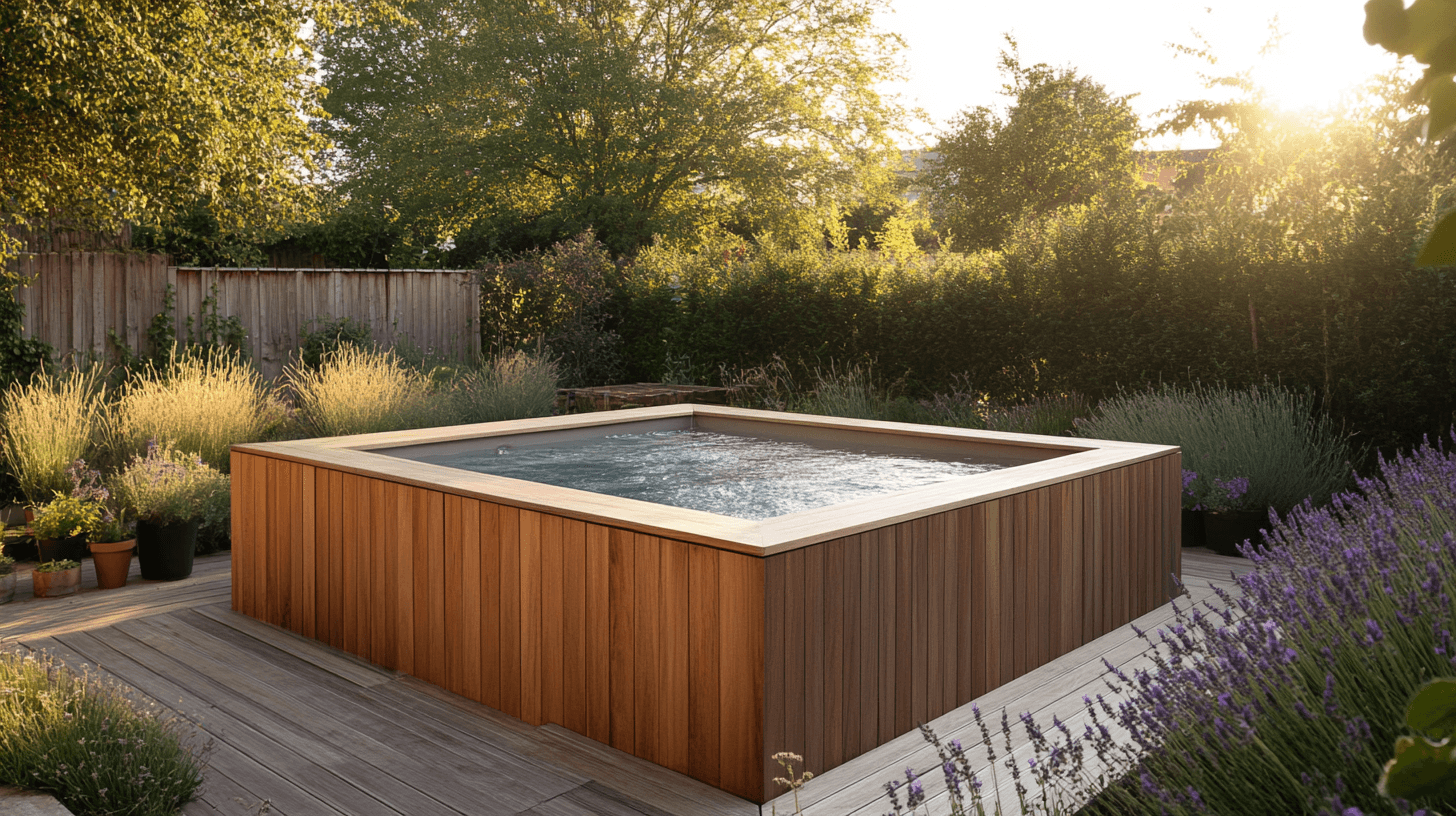
Essentials
The entry point to wooden above ground pool ownership.
Available in multiple sizes and shapes — ideal for families who want a proper pool without committing to the full investment of the Premium or Signature ranges.
Above-ground · Multiple sizes · From £3,000
Browse Essentials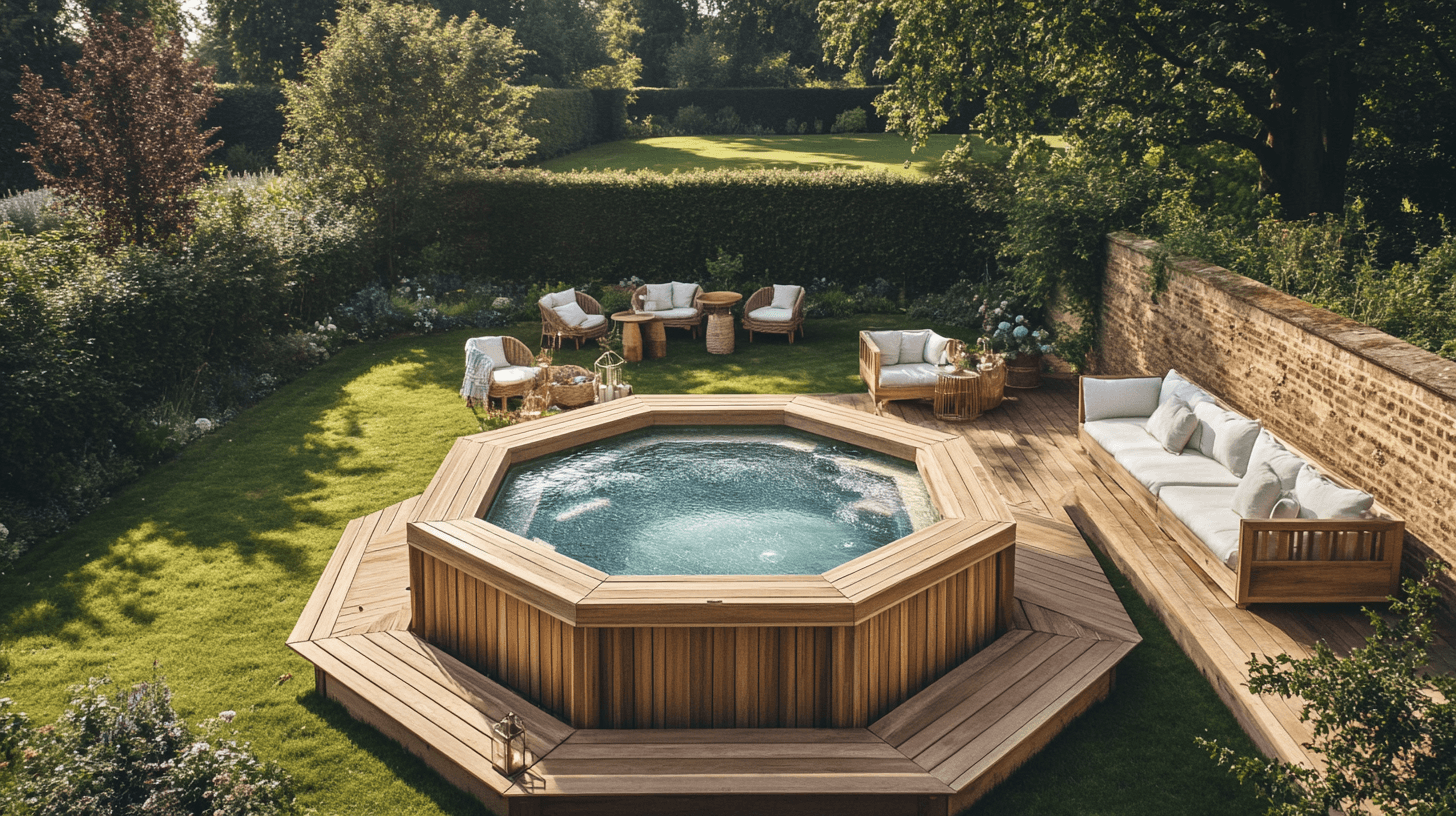
Premium
Our most popular above ground range.
Larger footprints, greater depth, more flexibility to choose a size that genuinely feels like a proper swimming pool. The right choice for most families.
Above-ground · Deep-water options · From £6,000
Browse Premium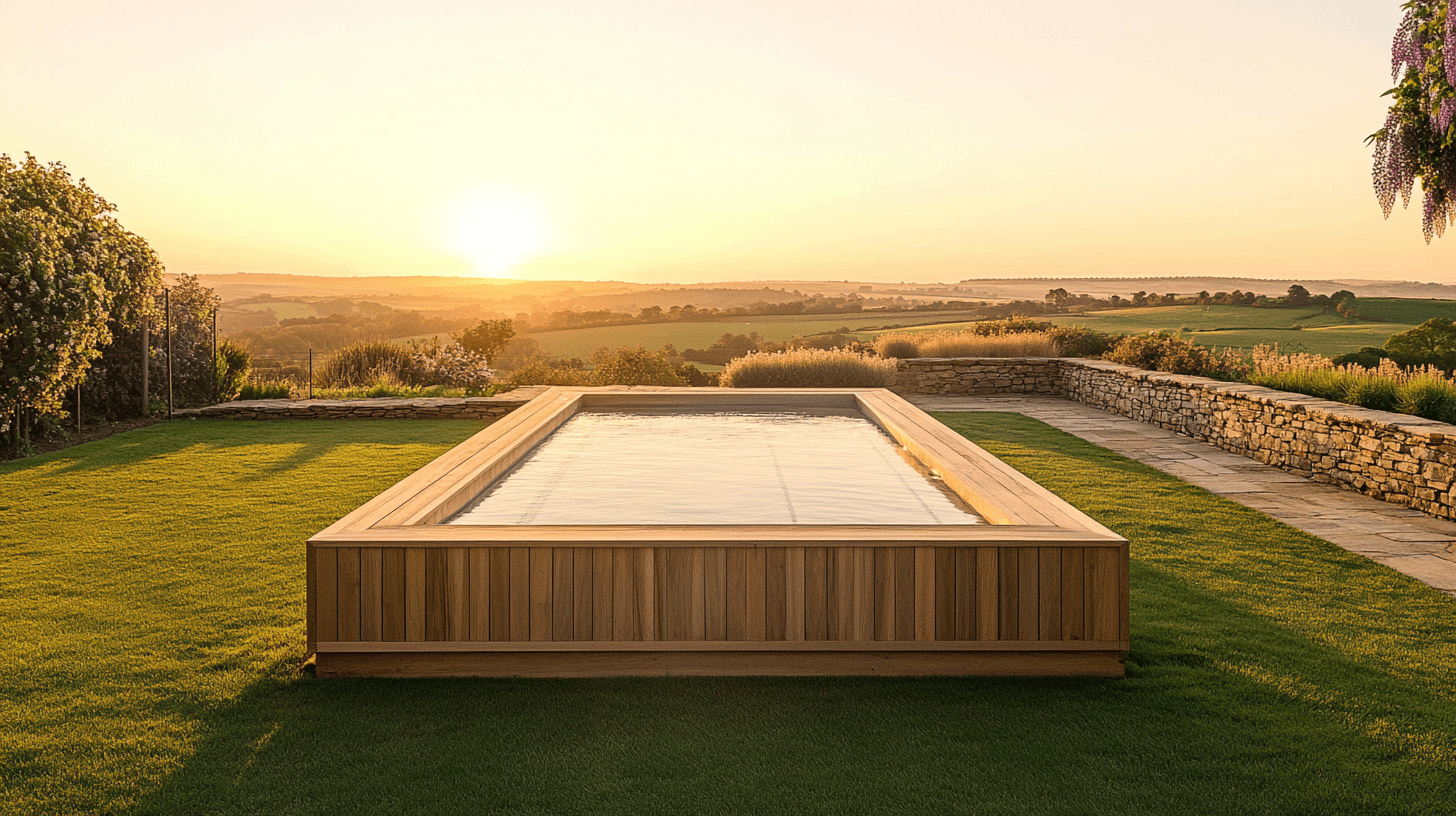
Signature
The finest above ground pools we make.
Generous dimensions, premium Nordic timber, and architectural shapes that make a real statement. Above-ground — but nobody would know it.
Above-ground · Architectural shapes · From £12,000
Browse SignatureExtend your season
Swim from April to October.
A heat pump transforms how much you use an above ground pool. For every 1 kW of electricity, a modern inverter heat pump delivers up to 5 kW of heat — making a warm pool affordable from early spring through to autumn.
What does an above ground pool cost to run?
Running costs are one of the most common things buyers ask about — and one of the most commonly overstated by people who don't actually own a pool. Here's what a typical wooden above ground pool costs to run in a UK garden over a 6-month season (April to October), for a mid-sized pool of around 25–30 m³ heated to 28 °C with a solar cover.
Heating (heat pump + solar cover)
Inverter heat pumps deliver 4–5× the heat energy per kWh used. A solar cover cuts overnight heat loss by up to 70%.
£300 – £700 / season
Filtration electricity
Pump runs ~6–8 hours a day on a sensible schedule.
£100 – £200 / season
Chemicals (chlorine, balancers)
Salt-water systems cost more upfront but reduce ongoing chemical spend.
£150 – £300 / year
Replacement consumables
Test strips, filter media, occasional cartridge replacement.
£40 – £80 / year
How much time does a pool actually take?
Around 30 minutes a week in season — skim the surface, run the vacuum (or a robot does it), test the water with a strip, and dose chlorine if needed. That's the whole job.
Add a half-day in spring to open the pool, and another half-day in autumn to winterise it (drain partially, blow out lines, fit the winter cover). Total annual time commitment is well under 30 hours.
Total cost of ownership. For a typical wooden above ground pool: roughly £600–£1,300 a year in running costs, spread across heating, filtration, and chemicals. Cheaper if you don't heat to 28 °C; more if you swim every day from April through October.
What base does an above ground pool need?
This is the part buyers underestimate most, and the part that causes almost every problem we get called about. An above ground pool doesn't need excavation — but it does need a properly prepared base. Water is heavy: a 5 m round pool at 1.2 m deep holds around 23 tonnes. That load has to sit on something flat, firm and genuinely level.
Compacted sub-base and sharp sand
Recommended for most poolsA 100–150 mm layer of compacted MOT Type 1, blinded with sharp sand and levelled. Drains well, spreads load evenly, and is the most cost-effective option for Essentials and Premium pools.
Reinforced concrete slab
Best for larger poolsThe most stable option and what we recommend for the largest Signature models, or anywhere the ground is soft, recently made up, or on a slope. More expensive, but permanent and completely predictable.
Existing patio or paving
Sometimes — check firstWorkable if the slabs sit on a proper sub-base, are level across the whole footprint, and the ground beneath can carry the load. Slabs laid on spot-bedded mortar over soft ground usually cannot.
Grass or bare soil
Not suitableGrass compresses unevenly under load and holds moisture against the timber. A pool set straight onto turf will settle out of level within a season.
Raised timber decking
Not without engineering inputMost domestic decks are built for people and furniture, not tens of tonnes of water. If you want a pool on or into a deck, the structure needs designing for it from the start.
How level is level enough? Aim for within 10 mm across the full footprint. At 30 mm out over 5 m you will see the tilt in the waterline every time you look at the pool, and the timber carries the load unevenly. It is far cheaper to get this right before the pool arrives than to correct it afterwards.
How an above ground pool is installed
Start to finish, a wooden above ground pool goes in over 1–3 days once the base is ready. There is no excavation, no concrete pour for the pool itself, and no waiting on a specialist contractor's schedule. Two competent people can handle most of our Essentials and Premium models; the larger Signature pools are easier with three.
- 1
Prepare the base
Mark out the footprint with a metre of working space around it, excavate the topsoil, lay and compact the sub-base, then blind and level. This is the slowest part and the one worth taking time over. Allow a day, or a day and a half if you are hiring a plate compactor.
- 2
Assemble the timber structure
The pool arrives as a kit of pre-cut, pre-drilled interlocking timber sections. They stack and lock together — no cutting, no specialist tools beyond a drill and a level. Check level again once the first two courses are down, because it is trivial to correct now and difficult later.
- 3
Fit the underlay and liner
A foam or felt underlay protects the liner from the base and adds a little insulation underfoot. The liner is then hung, smoothed out from the centre, and clipped or railed into place. Do this on a warm day if you can — liner material is far more cooperative above 15 °C.
- 4
Install the filtration and fittings
Cut and fit the skimmer and return inlet, connect the pump and filter, and route the pipework. Keep the plant within about a metre of the pool and on a firm, dry, ventilated spot with a weatherproof power supply installed by a qualified electrician.
- 5
Fill and commission
Fill in stages, checking the liner stays seated as the water rises. A 25–30 m³ pool takes roughly 18–30 hours on a domestic mains supply. Once full, run the filtration continuously for 24–48 hours, then balance the water before anyone swims.
- 6
Balance the water and swim
Set total alkalinity to 80–120 ppm first, then pH to 7.2–7.6, then chlorine to 1–3 ppm. Add stabiliser if the pool is uncovered and in full sun. Get this order right and the water stays easy to manage all season.
Prefer not to do it yourself? We can point you to installers who have put in our pools before. Read the full installation guide or talk to the team about your site.
Above ground swimming pools through a British winter
One of the questions we're asked most often is whether above ground swimming pools have to come down at the end of summer. For inflatable and frame pools, generally yes — which is part of why they don't last. A wooden above ground pool stays exactly where it is. It gets winterised, not dismantled.
Winterising takes about half a day in late October or early November. Drop the water level below the skimmer, drain the pump, filter and pipework so nothing can freeze and split, dose the winter chemicals, and fit a debris or winter cover. That's the job.
Crucially, don't empty the pool completely. The remaining water holds the liner in shape and balances the pressure on the timber walls. An empty pool over winter is more likely to cause problems than a part-filled one.
Opening again in spring is the reverse and takes about the same time: cover off, top up, reconnect the plant, shock the water, and balance it. Most customers are back swimming by late April with a heat pump running, or late May without one.
With a heat pump
Comfortable swimming from April to October. An inverter heat pump plus a solar cover is the single biggest change you can make to how much the pool actually gets used.
Without a heat pump
Realistically late May to early September in most of the UK, and heavily weather-dependent. A solar cover alone will still add a few degrees and a couple of weeks either side.
Safety around an above ground pool
An above ground pool has one built-in advantage over an in-ground pool: the water is a metre or more above the lawn, so a small child cannot simply walk or stumble into it. That is a genuine benefit, not a marketing point — but it is not a substitute for the basics.
A removable or lockable ladder
The simplest and most effective measure there is. If the ladder is away or locked, the pool cannot be entered unsupervised.
A cover you can rely on
A solar cover keeps heat in but will not take weight. If you have young children, specify a proper safety cover rated to support a load.
Clear, level access
Keep the surround free of trip hazards and choose a non-slip surface. Most pool injuries happen beside the water, not in it.
Supervision, always
No cover, alarm or fence replaces an adult watching. Agree who is responsible whenever the pool is open.
There is no single national standard covering private domestic pools in the UK, and requirements can vary locally. It is worth checking current guidance with your local authority and confirming the conditions your home insurer applies — some policies specify particular covers, fencing or alarms.
Common questions
What is the difference between an above ground pool and an in-ground pool?
An above-ground pool sits on the surface of your garden — no excavation required. An in-ground pool is set into a dug-out and sits flush with the garden. Above-ground pools are faster to install, lower cost, require no planning permission in most cases, and can be relocated. In-ground pools have a more integrated look and are a permanent garden feature.
How much does an above ground pool cost in the UK?
Costs vary significantly by type. Inflatable and basic frame pools cost £50–£500 but typically last only 1–3 seasons. Wooden above-ground pools — the kind we make — start from £3,000 and last 15–25 years with basic maintenance. They look far better in a garden and hold their value as a garden feature.
Do I need planning permission for an above ground pool in the UK?
In most cases, no. Above-ground pools are not considered permanent structures under UK planning law and typically fall within permitted development rights. We recommend checking with your local planning authority if you are in a conservation area or live in a listed building.
Are wooden above ground pools better than steel or inflatable?
For a UK garden, yes — in almost every way. Wooden pools look like part of the garden rather than temporary leisure equipment. They last 20+ years compared to 1–5 for inflatable or steel-frame alternatives. Nordic timber is naturally water-resistant and weathers beautifully. The upfront cost is higher, but the cost per year of use is lower than cheaper alternatives.
How quickly can I get an above ground pool installed?
Our wooden above-ground pools typically arrive 6–10 weeks from order and can be installed in 1–3 days. There is no excavation, no concrete groundworks, and no contractor delays. Most customers are swimming within a few weeks of placing their order.
Can I heat an above ground pool in the UK?
Yes. A heat pump is the most efficient way to do it — modern inverter heat pumps deliver up to 5 kW of heat for every 1 kW of electricity used. Our Thermotec range is compatible with all our above-ground pools and will extend your swimming season from April through October. A solar cover alongside the heat pump keeps running costs low.
Can the pool be relocated?
Yes. One advantage of an above-ground pool over an in-ground pool is that it can be dismantled and moved if you relocate. This is not something most customers do, but it is possible.
What base does an above ground pool need?
A flat, firm, level base is the single most important part of the installation. For our wooden above-ground pools we recommend a compacted MOT Type 1 sub-base topped with sharp sand, or a reinforced concrete slab for the larger Signature models. Level matters more than most people expect — a pool that is 30 mm out over 5 m will show a visible tilt in the waterline and puts uneven load on the timber. Grass alone is not a suitable base for a permanent wooden pool.
Can you put an above ground pool on decking or a patio?
On an existing patio, sometimes — if the slabs are laid on a proper sub-base, are genuinely level, and the ground beneath can carry the load. On timber decking, usually not without engineering input. Water is heavy: a 5 m round pool at 1.2 m deep holds roughly 23 tonnes. Most raised decks are not designed for that. Send us your site details and we will tell you honestly whether the base will work.
How long does an above ground pool last?
It depends entirely on what it is made from. Inflatable and basic frame pools typically last 1–3 seasons. Steel and resin frame pools last 5–10 years. A wooden above-ground pool built from pressure-treated Nordic timber will last 20–25 years or more with basic annual maintenance, and the liner is a replaceable consumable within that — typically 8–12 years.
How much maintenance does an above ground pool need?
Around 30 minutes a week in season: skim the surface, run the vacuum or let a robotic cleaner do it, test the water with a strip, and dose chlorine if needed. Add roughly half a day in spring to open the pool and half a day in autumn to winterise it. The timber itself needs very little — an annual check of the fixings and, if you want to hold the colour, a coat of timber oil every few years.
Can you leave an above ground pool up all year in the UK?
Yes — a wooden above-ground pool is designed to stay in place year-round. It is winterised rather than dismantled: lower the water below the skimmer, drain and protect the pump and pipework against frost, add winter chemicals, and fit a debris or winter cover. Leaving the pool empty over winter is worse than leaving it part-filled, because the liner can shrink and the structure loses the balancing pressure of the water.
How long does it take to fill an above ground pool?
A mid-sized above-ground swimming pool of 25–30 m³ takes roughly 18–30 hours on a typical domestic mains supply. Many customers fill overnight across two or three days, or arrange a tanker delivery for the larger Signature pools. It is worth telling your water supplier if you are filling a large pool, and checking whether you are on a meter.
What safety equipment should I have with an above ground pool?
At minimum: a removable or lockable ladder so the pool cannot be entered unsupervised, and a cover rated to take weight if you have young children. Many customers add a safety cover, an alarm, or fencing around the pool area. There is no single national standard for private domestic pools, so check current guidance and speak to your home insurer — some policies set their own conditions. Supervision remains the most important safety measure of all.
Ready to find your above ground pool?
Use our Pool Finder to get a shortlist of models that suit your garden, budget, and how you plan to use the pool — it takes about two minutes. Or speak to the team directly.